

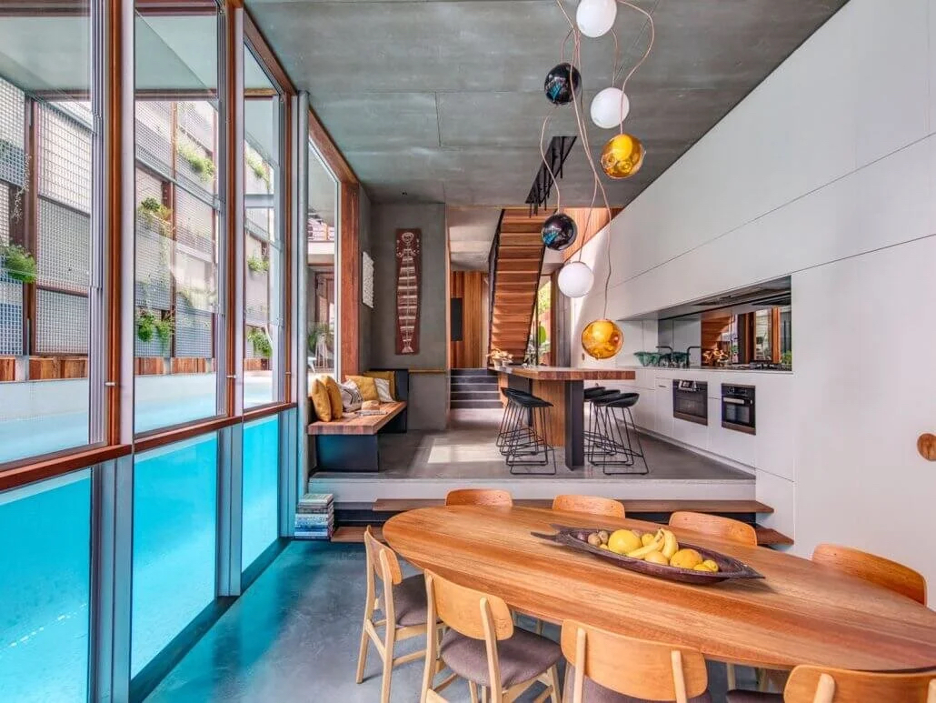
Faced with intensifying climate pressures, fragile coastlines, and a growing desire for lower-impact living, architects are rethinking what it means to build by the sea. Coastal homes today are no longer simply glass boxes positioned for a view. Instead, they operate as environmental systems—structures that harness wind and sun, respond to rising tides, and integrate local materials and ecosystems into their design. For this reason, passive cooling, elevated foundations, renewable energy systems, and adaptive building envelopes have become central strategies in contemporary coastal architecture. The most compelling examples are not only technically sophisticated but also architecturally refined. They use restraint and clarity to amplify the drama of their surroundings. Sustainable principles guide many of these new approaches.
For coastal homeowners and design enthusiasts alike, these projects offer a glimpse of how seaside living can evolve without sacrificing beauty or comfort. Around the world—from Australia’s windswept dunes to Brazil’s tropical Atlantic coast—architects are experimenting with structural ingenuity, modular construction, and climate-responsive planning. These innovations produce homes that are both aspirational and pragmatic. Many rely on passive solar orientation, natural ventilation, and renewable energy systems to reduce operational energy use. Others minimize footprint or employ prefabrication to limit disturbance to delicate landscapes. In fact, sustainable design features are increasingly a priority for coastal homes.
The following six coastal residences exemplify the direction of high-performance seaside architecture as we approach 2026. Each demonstrates how thoughtful design can transform environmental constraints into opportunities. In this way, architects create homes that are at once striking, efficient, and deeply attuned to the rhythms of the ocean. As a result, sustainable choices are shaping the next generation of coastal architecture.
Timber Modernism on Brazil’s Atlantic Coast
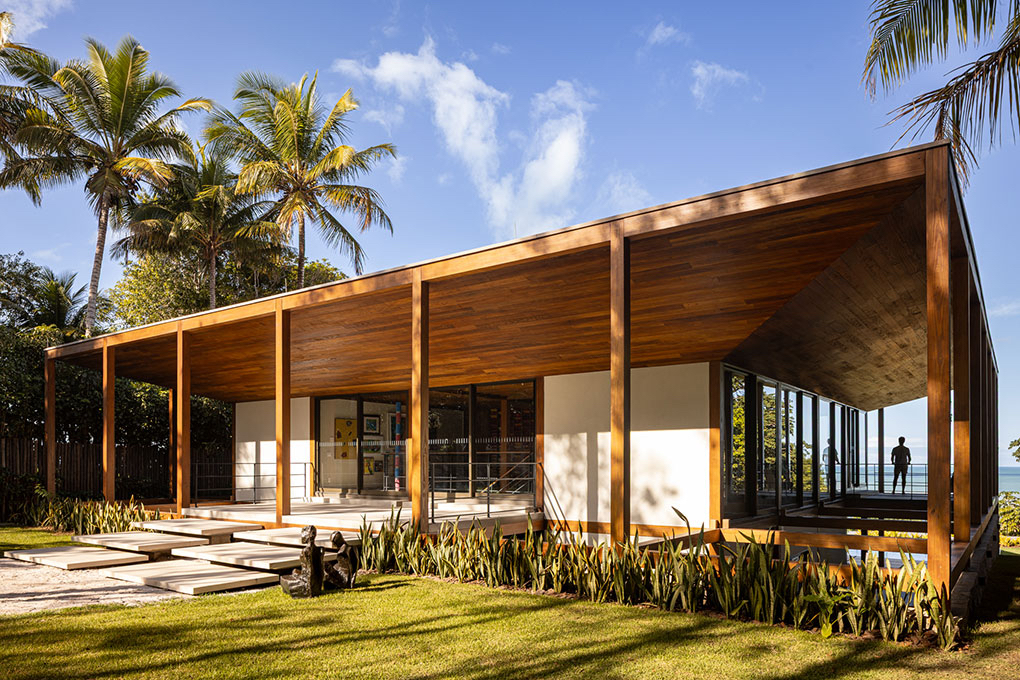
On a bluff overlooking Bahia’s pristine shoreline, the Itapororoca House demonstrates how modern architecture can merge with tropical ecosystems. Designed by the Brasília-based studio Bloco Arquitetos, the house uses glued-laminated timber to create a light structural frame that appears to hover above the landscape. Instead of dominating the terrain, the building steps into a natural slope. It appears as a single level from the entrance, but reveals multiple levels toward the sea. Wide verandas—an architectural feature rooted in Brazilian colonial design—create shaded outdoor living spaces that reduce heat gain while encouraging cross-ventilation. The timber structure minimizes embodied carbon and allows for prefabricated components that reduce disturbance to the protected coastal terrain. The result is a residence that feels both contemporary and deeply rooted in local architectural traditions. Overall, the project serves as an example of sustainable practices in coastal environments.
A Passive Maritime Retreat in New South Wales
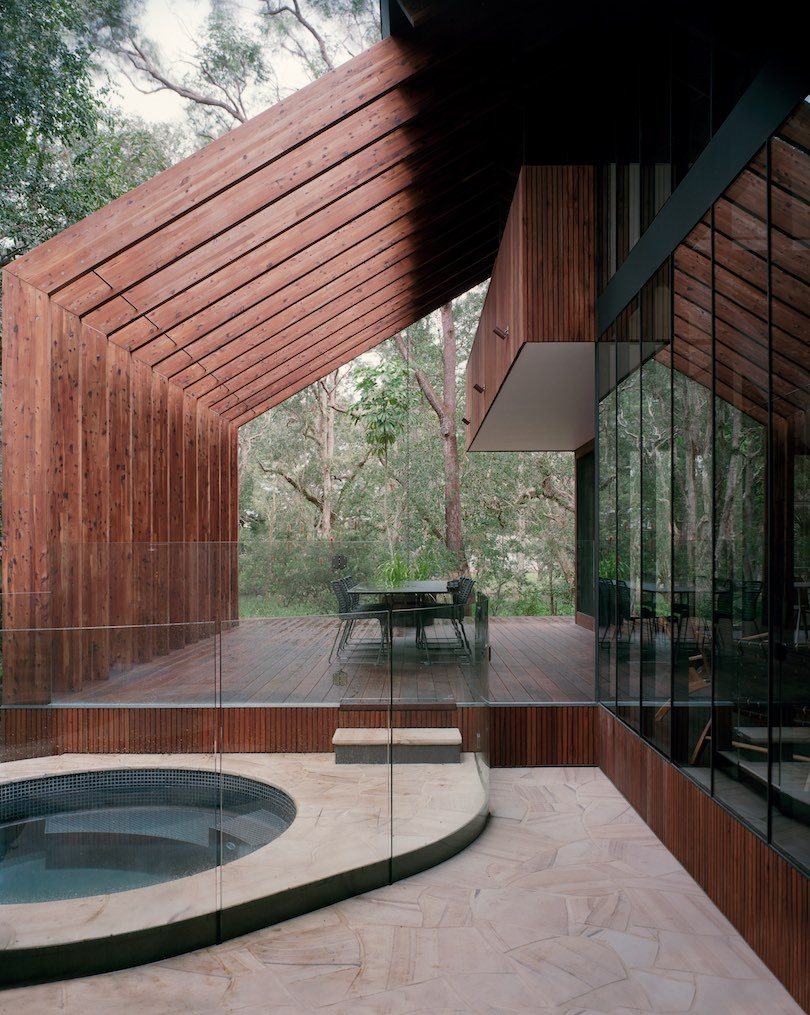
Tucked between lagoon and ocean along Australia’s Central Coast, Pearl Beach House by architect Justin Buckwell of Buckwell + Partners draws inspiration from maritime structures rather than conventional beach homes. Clad in timber and raised slightly above its surroundings, the house resembles a contemporary boathouse—an intentional nod to the region’s coastal culture. Passive solar principles shaped the building’s orientation, allowing winter sunlight to penetrate deeply into the interior. In contrast, roof overhangs shade the glass during hotter months. Large operable openings promote cross-ventilation, reducing the need for mechanical cooling. Inside, a restrained material palette and open plan emphasize durability and flexibility for multigenerational use. By focusing on passive strategies rather than technological complexity, the project demonstrates how thoughtful orientation and material selection can dramatically reduce energy demand. At the same time, it maintains a refined architectural presence.
A Minimalist California Coastal Prototype
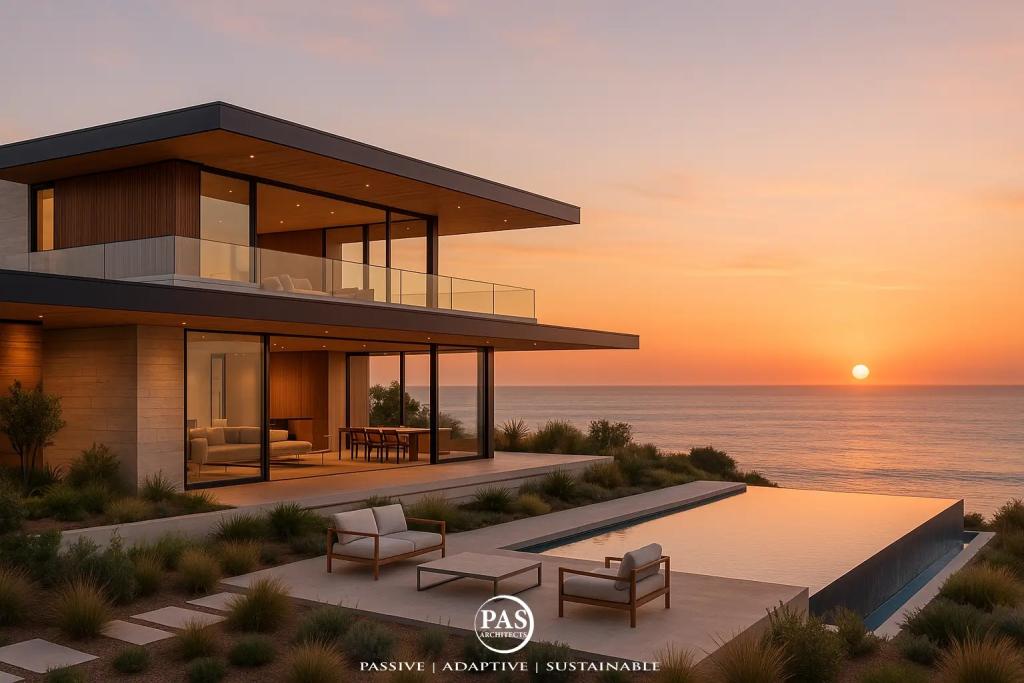
Along the Pacific coast of California, the conceptual Rise Residence by PAS Architects explores how minimalism and environmental performance can coexist in contemporary beach architecture. The home’s clean geometry—defined by limestone, teak, and white stucco—creates a restrained silhouette that blends into the rugged coastal terrain. Wide roof overhangs and carefully placed glazing optimize daylight while preventing overheating, a crucial strategy in California’s increasingly warm climate. Limestone flooring helps regulate interior temperatures, and generous openings create continuous airflow from ocean breezes. The plan emphasizes seamless indoor-outdoor living. Terraces and shaded decks function as extensions of interior space. Rather than relying heavily on mechanical systems, the design relies on passive cooling, shading, and natural ventilation to achieve a comfortable interior environment. Clearly, sustainable solutions play an important role in this coastal home.
A Surf-Inspired Retreat in Cornwall
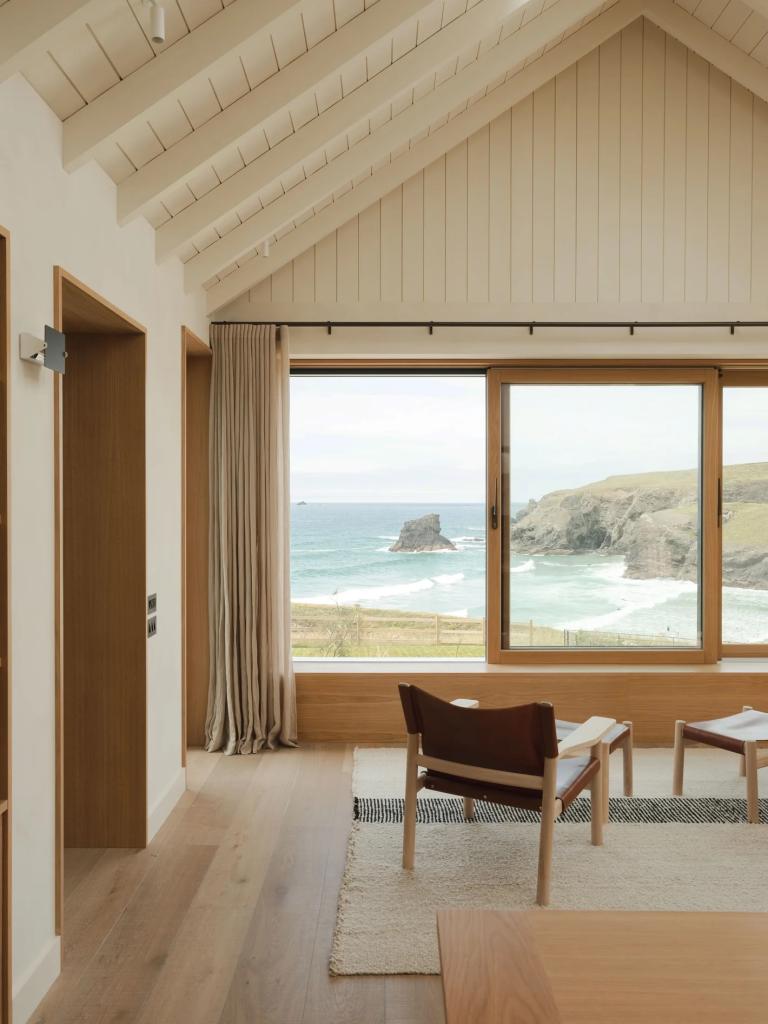
On the windswept cliffs of England’s north coast, the Cornwall Retreat designed by London-based studio De Rosee Sa offers a refined interpretation of coastal vernacular architecture. Timber cladding, dark window frames, and a gabled roof echo traditional seaside structures while maintaining a distinctly contemporary profile. The layout is organized around expansive sea-facing windows. These treat light and view as architectural materials. Natural finishes—including lime plaster, oak floors, and clay paints—help regulate humidity and create a low-toxicity interior environment. The architects also incorporated a wildflower landscape that stabilizes the coastal soil while promoting biodiversity. Purpose-built features such as surf-changing areas and bunk rooms reflect the owners’ active seaside lifestyle. Therefore, the project illustrates how sustainable design can align with the rhythms of coastal recreation.
A Reimagined Beach House in Montauk
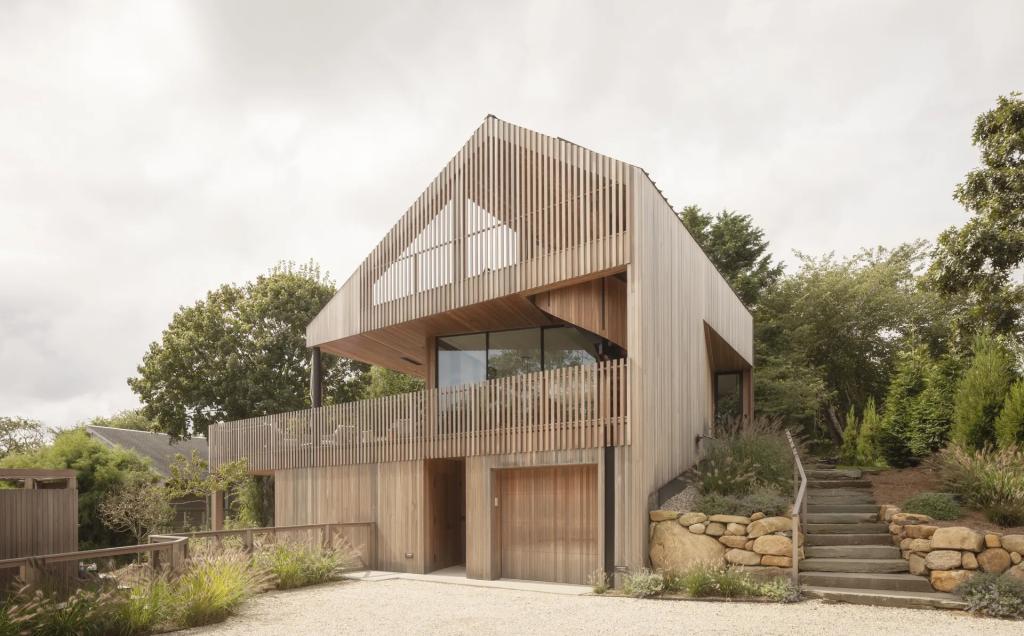
At the eastern edge of Long Island, the Hither Hills House demonstrates the sustainability potential of adaptive reuse. Designed by architect Nilay Oza of Oza Studio Architects, the project began as a modest structure that many would have demolished. Instead, the architect reoriented and expanded the house to capture ocean views while preserving the existing framework. Vertical wood cladding unifies the exterior while improving insulation and durability in the coastal climate. A roof deck and open living areas maximize natural light and ventilation, reducing reliance on artificial cooling. By transforming rather than replacing the original structure, the project significantly reduced construction waste and embodied carbon. The result is a sophisticated seaside home that demonstrates how renovation can be as innovative—and environmentally responsible—as new construction.
At the eastern edge of Long Island, the Hither Hills House demonstrates the sustainability potential of adaptive reuse. Designed by architect Nilay Oza of Oza Studio Architects, the project began as a modest structure that many would have demolished. Instead, the architect reoriented and expanded the house to capture ocean views while preserving the existing framework. Vertical wood cladding unifies the exterior while improving insulation and durability in the coastal climate. A roof deck and open living areas maximize natural light and ventilation, reducing reliance on artificial cooling. By transforming rather than replacing the original structure, the project significantly reduced construction waste and embodied carbon. The result is a sophisticated seaside home that demonstrates how renovation can be as innovative—and environmentally responsible—as new construction.
Circular Simplicity at St Andrews Beach, Australia
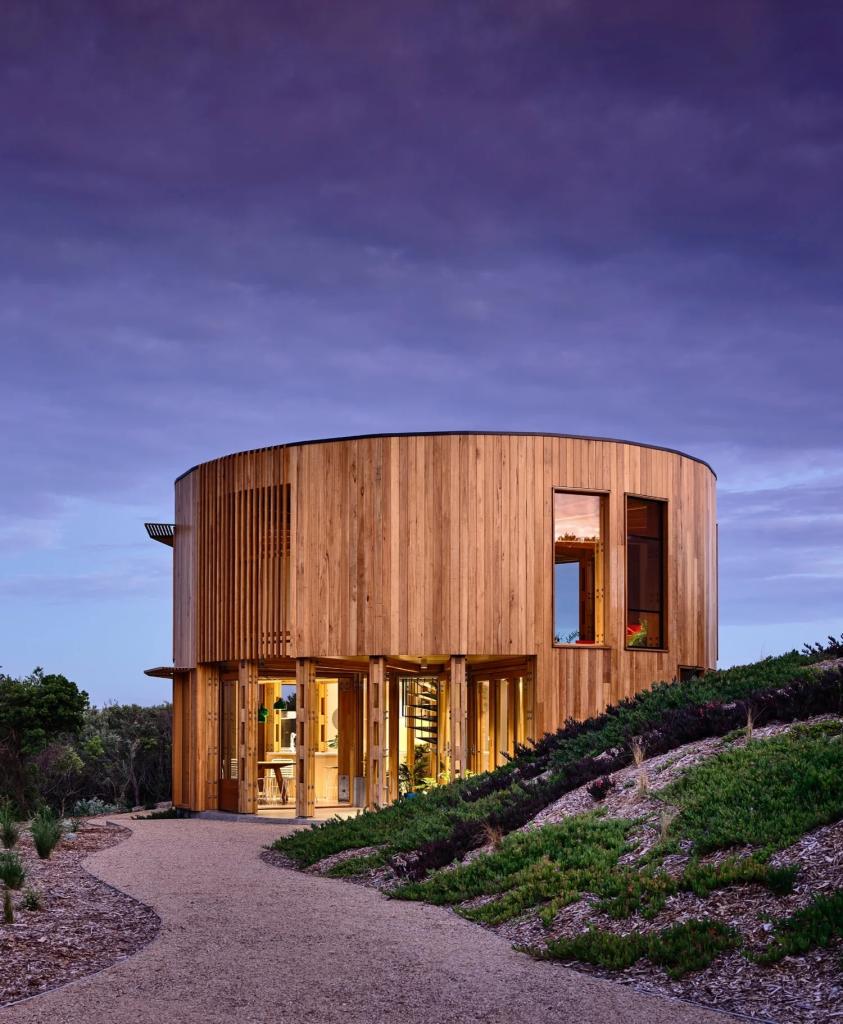
One of the most unconventional coastal dwellings of recent years is the St Andrews Beach House, designed by the Melbourne studio Austin Maynard Architects on Australia’s rugged Mornington Peninsula. Rather than pursuing scale, the architects embraced radical compactness: the home occupies a circular footprint less than five meters in radius, sitting quietly among sandy coastal vegetation. This geometry produces a fluid interior without corridors.
As a result, the design encourages occupants to move freely through interconnected living spaces. Sustainability drives the design at every level. Solar panels power the home’s energy needs, rainwater is collected in a concrete tank for reuse, and highly insulated glazing maximizes passive solar performance. Materials were selected for durability in harsh coastal winds, allowing the structure to weather naturally with minimal maintenance. By minimizing footprint and embracing modest scale, the house reimagines the beach retreat as a low-impact shelter. It is not a sprawling coastal estate.
Across continents and climates, these projects reveal a clear shift in coastal architecture. Rather than imposing monumental forms on fragile shorelines, the most forward-thinking architects are embracing restraint, responsiveness, and ecological intelligence. Compact footprints, renewable materials, passive cooling strategies, and adaptive reuse are becoming defining characteristics of contemporary seaside design. For coastal homeowners and architecture enthusiasts, these residences offer more than aesthetic inspiration. Ultimately, they represent a blueprint for how life by the ocean can evolve—where innovation and environmental stewardship coexist, and where the most impressive architecture is often the kind that allows the landscape itself to remain the star. For more design inspiration, visit Beach Homes Lifestyles.